

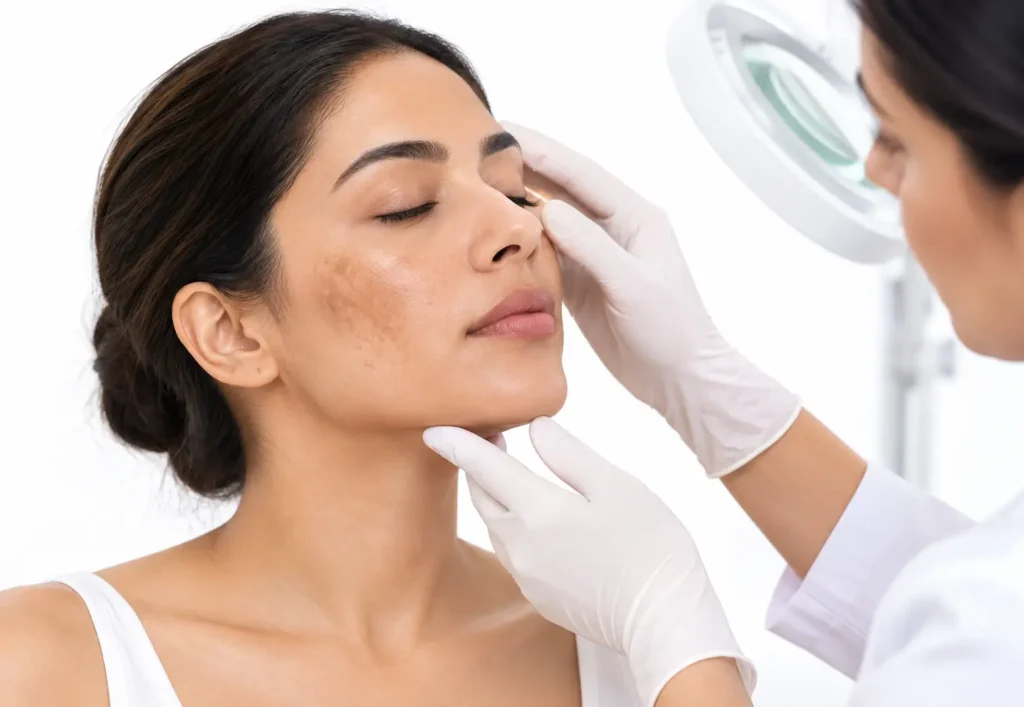
You treated the pigmentation. The marks faded. Your skin looked clearer for a while.
Then, gradually, the patches started becoming visible again.
Maybe it happened after a holiday in the sun. Maybe another acne breakout left behind new marks. Or perhaps the pigmentation returned even though you were still using your favourite brightening serum.
For many people, this creates a frustrating cycle: treat, improve, stop, and watch the pigmentation come back.
But recurrent pigmentation does not necessarily mean that your previous treatment failed. Often, the visible pigmentation has been reduced, but the factors responsible for triggering excess pigment are still present.
That is why long-term pigmentation management is about more than simply making dark spots lighter. It involves understanding what type of pigmentation you have, what is triggering it, how your skin responds to treatment and how the results will be maintained over time.
At Skin Series, pigmentation is approached as a skin concern that needs assessment rather than a problem that can be treated with the same solution every time. Post-acne marks, sun-induced pigmentation, uneven skin tone and conditions such as melasma can behave differently and may require different approaches.
The goal is not simply temporary brightness.
The goal is clearer, more even-looking skin supported by a treatment and maintenance strategy that addresses the factors contributing to recurrence.
Why Does Pigmentation Keep Coming Back?
Pigmentation occurs when the skin produces or retains more melanin, the pigment responsible for skin colour. It can appear as dark spots, patches, acne marks or an uneven complexion.
The important thing to understand is that pigmentation is often a response to another trigger.
If that trigger continues, your skin may continue producing excess pigment even after previous pigmentation has faded. This is why you can see improvement after treatment and then notice new or returning pigmentation weeks or months later.
Some common reasons include:
- Ongoing sun and visible-light exposure
- Repeated acne or skin inflammation
- Picking, scratching or irritating the skin
- Hormonal changes
- Using overly aggressive treatments
- Irritating skincare products
- Stopping maintenance too early
- Treating the wrong type of pigmentation
- Certain medications or underlying skin conditions
So instead of only asking, “Which treatment removes pigmentation?”, it is often more useful to ask:
“Why is this pigmentation happening, and what is causing it to return?”
This distinction becomes particularly important for medium and darker skin tones, which can be more prone to post-inflammatory pigmentation and may develop more noticeable pigmentation following skin irritation or inflammation.
1. Ongoing Sun Exposure May Be Triggering Pigmentation
Sun Exposure Is One of the Biggest Reasons Pigmentation Returns
You may have completed a treatment and followed your skincare routine consistently, but regular sun exposure can still encourage pigment production.
UV radiation can stimulate melanin production and make existing pigmentation appear darker. Visible light can also contribute to pigmentation, particularly in people with darker skin tones and those prone to melasma.
This is why sun protection is not simply an additional skincare step when you are treating pigmentation. It is part of the treatment strategy.
For pigmentation-prone skin, consistent broad-spectrum sunscreen is important. Depending on your pigmentation and skin type, your doctor may also recommend tinted sunscreen containing iron oxides, which can provide additional protection against visible light.
Treatment can reduce existing pigmentation, but if the same triggers continue to affect your skin every day, maintaining the improvement becomes more difficult.
2. Acne and Inflammation Are Still Creating New Marks
Your acne may have cleared, but the pigmentation it left behind can remain.
Then another breakout appears. It heals. Another dark mark develops.
This is known as post-inflammatory hyperpigmentation, where darker areas develop after inflammation or injury to the skin. Acne is a common trigger, but irritation, dermatitis, burns and other inflammatory conditions can also leave pigmentation behind.
This creates an important treatment principle:
If new inflammation continues, new pigmentation can continue forming.
You may be successfully fading older marks while your skin is simultaneously developing new ones.
That is why someone with active, uncontrolled acne may need to address the acne itself before focusing primarily on pigmentation. If acne is the trigger, treating only the resulting marks may not solve the underlying problem.
For persistent acne and recurring breakouts, the Skin Series Acne Erase Program may be a more appropriate starting point, depending on your doctor’s assessment.
3. You May Be Treating the Wrong Type of Pigmentation
Not every dark patch is the same.
Two people may appear to have similar pigmentation, but one may have post-acne marks, another may have melasma, and another may have pigmentation associated with medication or another underlying condition.
These concerns do not necessarily respond to the same treatment.
Melasma, for example, can be influenced by sunlight, hormones, pregnancy and certain medications. It can also be persistent and may require ongoing management rather than a single treatment.
This is why assessment should come before treatment.
Before deciding how pigmentation should be treated, your doctor may need to consider:
- What type of pigmentation you have
- Where the pigmentation is located
- How deep or persistent it appears to be
- Your skin tone and how your skin responds to inflammation
- Possible triggers
- Whether there is an active underlying skin concern
If the pigmentation type is misunderstood, even a treatment that successfully reduces visible pigment may not give you the long-term improvement you are expecting.
4. Your Treatment May Have Been Too Aggressive
When pigmentation is stubborn, it can be tempting to believe that stronger treatment will automatically produce faster results.
But with pigmentation-prone skin, more aggressive does not always mean more effective.
Excessive irritation can trigger inflammation, and inflammation can contribute to further pigmentation. Certain peels, lasers and light-based procedures can also aggravate pigmentation in some people when the treatment is not appropriately selected or adjusted for their skin.
This is particularly important for brown and Indian skin tones.
Brown Skin Needs a Thoughtful Treatment Approach
Indian and brown skin can be more susceptible to post-inflammatory pigmentation. This means that unnecessarily irritating or aggressive treatment can sometimes become part of the problem.
That does not mean pigmentation cannot be treated effectively.
It means treatment needs to be carefully selected and appropriately calibrated.
The right treatment depends on the pigmentation, the skin, the trigger, the treatment intensity and how your skin responds throughout the process.
This is one reason doctor-led assessment and ongoing review can make an important difference.
5. You Stopped Your Routine Once Your Skin Looked Better
Seeing your pigmentation fade can feel like the finish line.
But for pigmentation-prone skin, improvement and maintenance are two different stages.
If you stop every protective and corrective step as soon as the skin looks clearer, the original triggers may continue affecting your skin and pigmentation can gradually return.
A useful way to think about pigmentation management is through three stages.
Correct
Reduce existing pigmentation through an appropriate treatment plan.
Protect
Reduce exposure to factors that can stimulate pigmentation, including UV radiation, visible light and unnecessary skin irritation.
Maintain
Continue with a personalised skincare and maintenance strategy designed to help preserve the improvement.
The treatment itself is only one part of the journey.
What happens between and after treatments matters too.
6. Your Skincare Routine May Be Irritating Your Skin
Sometimes the attempt to treat pigmentation can actually create more irritation.
Using multiple strong acids, excessive exfoliation or too many active ingredients at once can leave the skin irritated. Repeated stinging or burning is not necessarily a sign that a product is working.
For pigmentation-prone skin, the focus should be on achieving effective correction without unnecessarily disturbing the skin barrier.
You do not necessarily need a complicated 10-step routine.
Sometimes your skin needs fewer products, better consistency and a plan suited to your skin.
If your current routine regularly causes burning, redness, peeling or irritation, speak with a doctor before adding more active products.
7. The Pigmentation May Be More Persistent Than It Looks
Pigmentation does not always sit at the same level within the skin.
Some pigmentation is relatively superficial, while other pigment can be more persistent and take considerably longer to improve.
This is one reason why expecting one facial, one peel or one laser session to completely correct long-standing pigmentation can lead to unrealistic expectations.
Pigmentation correction is usually progressive rather than instant.
Your skin needs time to respond, and your treatment plan may need to be adjusted based on that response.
Pigmentation Correction Takes Patience
The right treatment plan is not necessarily the most aggressive one.
It is the one that considers your pigmentation, your skin and your response over time.
Progress can be assessed throughout treatment so that the approach can be adjusted when needed.
Why Is a Single Treatment Often Not Enough?
A One-Time Treatment vs a Structured Pigmentation Program
A single cosmetic treatment may provide temporary brightness or improvement in the appearance of pigmentation. However, it may not address why the pigmentation developed or how to maintain the improvement.
A structured program takes a different approach.
A Single Treatment
- May focus primarily on visible pigmentation
- May provide temporary improvement
- May not fully address the original trigger
- May not account for the type or persistence of pigmentation
- Does not necessarily include ongoing assessment
- Can encourage a reactive approach where treatment is repeated whenever pigmentation becomes noticeable
A Structured Pigmentation Program
- Begins with assessing the pigmentation and possible triggers
- Uses a planned treatment pathway rather than relying on a single session
- Allows treatment to be reviewed and adjusted based on skin response
- Can combine in-clinic treatment with personalised home care
- Tracks progress over time
- Includes guidance for protecting and maintaining the results
This is the approach behind the Skin Series Blemish Free Program.
The Skin Series Blemish Free Program: A Structured Approach to Pigmentation
You may have cleared your acne, but the marks can remain.
The breakout is gone. The inflammation has settled. Yet when you look in the mirror, you still see dark spots, uneven tone or patches of pigmentation.
The Skin Series Blemish Free Program is designed for this stage: when the skin has improved, but the visible pigmentation still needs attention.
It is not designed as a one-session brightness treatment.
It is a structured, doctor-led pigmentation correction program that combines progressive in-clinic treatment, personalised home care, ongoing review and maintenance guidance.
Pigmentation Is Rarely Just Pigmentation
At Skin Series, treatment begins with understanding your skin rather than immediately choosing a procedure.
Your doctor considers:
- The type of pigmentation
- The appearance and persistence of the pigmentation
- Your skin tone and how your skin behaves
- Possible triggers contributing to recurrence
- Your overall skin quality
- Your treatment history and skincare routine
Once your skin has been assessed, a treatment pathway can be planned around your specific concern.
Post-acne pigmentation, tanning, uneven tone and melasma may require different approaches. The aim is to avoid treating every dark spot as if it were the same condition.
How the Blemish Free Program Works
01. Initial Skin Assessment
The process begins with a clinical assessment of your pigmentation, skin type, tone concerns and overall skin behaviour.
Your treatment plan is built around your skin.
Not a generic template.
02. Structured Depigmenting Laser Sessions
The Blemish Free Program includes six medical-grade Q-Switch laser sessions, with the exact treatment approach and suitability determined by your doctor based on your pigmentation and skin response.
The sessions are structured as part of a progressive treatment pathway rather than being treated as isolated procedures.
03. Personalised Home Care Protocol
What happens between your sessions matters.
Your doctor may recommend a personalised medical skincare protocol to complement your in-clinic treatment and support the progress being made.
Your home care is selected according to your skin and treatment pathway rather than being treated as an afterthought.
04. Doctor Review at Every Session
Your skin may respond differently as treatment progresses.
That is why your doctor reviews your skin and its response throughout the program. Treatment parameters can be adjusted when appropriate based on your progress and individual response.
This ongoing review is an important part of a structured medical approach.
05. Progress Tracking
Pigmentation can improve gradually, which is why tracking progress matters.
Your skin can be assessed against its baseline throughout the treatment journey, helping you and your doctor understand how your pigmentation is responding rather than judging the result from a single day or photograph.
06. Post-Program Maintenance Guidance
The final treatment session is not necessarily the end of pigmentation management.
Once the correction phase is complete, you receive guidance on protecting your skin and maintaining the improvement.
Because the goal is not simply to get clearer skin.
It is to help you maintain clearer skin.
What Results Can You Expect?
Realistic Results and Timelines
Pigmentation correction is progressive, and results vary from person to person.
Some patients may notice early improvements in brightness and evenness as treatment progresses, while more persistent pigmentation may take longer to respond.
The Blemish Free Program follows a structured treatment pathway with multiple sessions, personalised home care and doctor review.
Your results can depend on factors such as:
- The type of pigmentation
- How persistent it is
- Your skin tone and skin behaviour
- The triggers contributing to pigmentation
- Your response to treatment
- How consistently you follow your prescribed home care
- Your ongoing sun protection
What About Downtime?
The program is designed to involve minimal downtime after treatment, but the experience can vary depending on the individual and the treatment settings used.
Your doctor will explain what to expect before your session and provide appropriate aftercare guidance.
Who Is the Blemish Free Program For?
The program may be considered if:
- You have post-acne marks or post-inflammatory pigmentation that has not faded adequately
- Your skin tone appears uneven or patchy
- You have tried multiple brightening products without meaningful improvement
- You want a structured, doctor-led approach instead of another one-off facial
- You have pigmentation that requires progressive correction
- Your acne has cleared but the marks remain
However, suitability cannot be determined from pigmentation alone. A consultation is important to understand what is causing the pigmentation and whether this program is appropriate for you.
Who May Need a Different Approach?
The Blemish Free Program is not a universal solution for every pigmentation concern.
A different treatment pathway or medical evaluation may be more appropriate for concerns such as:
- Active, uncontrolled acne that continues to create new marks
- Melasma requiring a different management strategy
- Acanthosis nigricans
- Pigmentation associated with an underlying medical condition
- Pigmentation related to certain medications
If there is an active condition causing new pigmentation, that underlying concern may need to be addressed first.
How Can You Reduce the Chances of Pigmentation Coming Back?
There is no way to guarantee that pigmentation will never recur. The risk depends on the type of pigmentation, your skin and whether the original triggers continue.
However, a long-term strategy can help reduce avoidable triggers.
1. Identify the Type of Pigmentation
Do not assume every dark patch is the same.
Post-inflammatory pigmentation, melasma, tanning and medication-related pigmentation can have different causes and may require different approaches.
2. Address the Original Trigger
If acne is creating new marks, the acne needs attention.
If irritation is causing inflammation, simplify your skincare routine.
If hormones, medication or another factor may be contributing, discuss it with your doctor.
3. Protect Your Skin Every Day
Consistent sun protection is one of the most important parts of long-term pigmentation management.
Depending on your pigmentation and skin tone, your doctor may also recommend protection against visible light.
4. Avoid Over-Treating Your Skin
More products are not always better.
More aggressive treatments are not always better.
The aim is to reduce existing pigmentation without creating unnecessary irritation that could contribute to further pigmentation.
5. Follow a Maintenance Plan
Pigmentation-prone skin often benefits from continued protection and maintenance even after the skin looks clearer.
Your doctor may recommend ongoing medical skincare, consistent sun protection and, where appropriate, maintenance treatments.
Pigmentation Treatment Should Be a System, Not a Reaction
When pigmentation appears again, it is easy to immediately look for another serum, facial or stronger treatment.
But recurring pigmentation often requires a more thoughtful approach.
01. Assess Before You Treat
Your doctor first considers your pigmentation pattern, skin tone, skin behaviour and possible triggers.
The cause matters.
Your skin matters.
Your response to treatment matters.
02. Correct Progressively
Pigmentation correction is not necessarily about trying to remove everything as quickly as possible.
A structured treatment pathway allows progress to be reviewed and the approach adjusted according to your skin’s response.
03. Protect and Maintain
Once pigmentation improves, protecting the skin becomes an important part of preserving the result.
Your personalised home care, sun protection and maintenance guidance all contribute to the long-term strategy.
Final Thoughts: Stop Treating Pigmentation Reactively
If your pigmentation keeps coming back, the answer may not be another stronger serum, another facial or a more aggressive treatment.
It may be a better plan.
A plan that asks why the pigmentation developed.
A plan that considers your skin tone and how your skin responds to inflammation.
A plan that treats progressively rather than reactively.
And a plan that includes both correction and maintenance.
The Skin Series Blemish Free Program is built around this approach, combining structured pigmentation treatment with personalised home care, doctor review and guidance for maintaining the improvement.
Your acne may have cleared.
But the marks don’t have to stay.
If pigmentation has been recurring despite your skincare efforts, the first step is understanding what is causing it and whether a structured treatment approach is right for you.
Book an Appointment with Skin Series to have your pigmentation assessed and discuss the most appropriate treatment pathway for your skin.
Note: This article is intended for general education and does not replace a medical diagnosis or personalised medical advice. Pigmentation can have different causes, and the appropriate treatment should be determined after a professional assessment.


